Friday, June 17, 2011

China!


Not a standard topic for Grid Knowledge, but I did go for a symposium on creating positive change, so I'm making the leap that anyone interested in emerging trends will be fascinated by the sites, smells, sounds and solutions now seen in the world's new super-power.

Amazing, astounding, breath-taking. A new China. It was an enchanting trip, better told with 100 pictures than 1,000 words so here's my Picassa sets semi-sorted and labelled:


Now the words, for there are so many stories and so much learned:
At Sias International University (site of the WAFW symposium), I saw college students studying from 6am til 11pm. At Xi'an, I saw a city weaving it's place as ancient city with a new focus on smart industry.

In Beijing, I saw a city reinventing itself overnight. Light rail anywhere you might want to go, installed in a few short years. (In Phoenix, we fight for years to run one short line and still quibble over the value of public transportation in a West owned by the wealthiest drivers.) Beijing was Ming's Tomb and the Forbidden City; the Summer Palace and lessons from Dr. Tea. It was the crazy, all-night "walking street" of food and trinkets and treasures. It was elegant meals and live centipedes eaten on a stick. It was breath-taking.

In Shanghai, oh the sites and sounds and smells and markets and gardens. They say Beijing is China's DC and Shanghai is the mainland's New York City. I suppose that's right. It was exciting from early morning till I couldn't keep my eyes open at night. It was Old Town Shanghai and endless skyscrapers; the public gardens and the crowded, colorful markets; it was high culture and all-night massage shops. It was a shopper's dream, and although I am NOT a shopper, I couldn't resist visiting the beautiful pearl and silk markets and the not-legal designer back alley stores. I loved it all, spent too much, ate almost everything (rank, "stinky tofu", yes; live centipedes on sticks...no). It was my favorite city because I was there with my friend Elena Zee, where she was raised and her family showed me more kindness than I deserved. Plus, I got my colleague and symposium travel partner/pal, Kathy Puckett, to come with me - so even the travel from Beijing (including missed connections and 24-hr layovers) was a lifetime memory of fun.

I can't begin to describe how little I understood what Fareed Zakaria speaks of when he writes about "Post American World 2.0" until I saw China with my own eyes. There, children in kindergarten are learning English. The government is moving to create a strong, modern infrastructure. The people have a hope, energy and enthusiasm about the future that the USA seems to have surrendered to bickering and internal discord. There is excitement in the streets and people do their best or "eat bitter" without complaint, working to create something new.
I want that for my people as well. I want that for students at ASU. I want that love of the future to exist in me.

Not that it was all good. Many believe it's moving too fast, and there are consequences to ignoring problems with environment, growth, relocation, and the taste of capitalism becoming a hunger incompatible with a firm, Communist government. There's also Tibet, Mongolia and the Western China regions beginning to raise up and ask for recognition of identity. We don't hear much about this, and the Chinese hear less, but it's happening. Because the 21st Century is a new time and a new story for China.

It went by too fast: I saw so much, learned so much, have already forgotten too much. I have to go back, and travel that massive landscape more slowly. Till then, my memories are recorded in piles of digital shapes and colors up at Picassa. They're only a poor simulcra of my experiences over 17 days, 5 cities...but it's a start.

Monday, May 2, 2011

Revisiting Plagiarism

In an age when collaboration, teaming and consensus-based decisions become more important and emphasized in the work place, incorporating these practices into meaningful assessment continues to challenge higher education. How do we know that our students know what we need them to know?
Adding to the challenge, thoughtful instructors attempting to foster digital literacy and the use of technology in rich ways in the course experience find that the most effective tools also make it easier for learners to "collaborate" where not intended by the instructor.

One of the most challenging tools for instructors is the use of online testing. The affordances include the ability to offer more small tests with lower stakes because the burden of grading is lightened. But how do we know they're not cheating??

In "traditional", face-to-face courses, online tests also save valuable class time both in delivery and in eliminating paper return. And they include the value to the student of instant feedback on understanding. The consequences of this transfer of exams to the digital space means we hear more stories of extending study groups to the exam taking. Students gather, enter the exam, and compare responses. Many honestly are surprised when "caught" and informed this is not allowed.

Here, the burden has to lie with the instructor who assumes their notion of assessment and ethical behavior is the same for the students. Unless directly stated in the syllabus or in the directions for the test, collaborating on an assessment may not be wrong in the eyes of the students. If the instructor believes it is wrong, they need to state that. And, once stated, if the instructor realizes that their values and ideas on assessment is not the same as that of many students, the instructor has a number of options. Electronic options; not whining like the crazy fellow in Florida because students had access to a large pool of possible questions and studied them all.

Keeping up with practices seen, technology enables an instructor to prevent collaboration as surely as it enables the learners to compare answers. Especially if the LMS is Blackboard with its plethora of unused assessment options. Creating an exam using a) randomized questions, b) randomized answers, c) pools where each student gets a different set of questions, and d) multiple formats for questions makes it very, very hard for students to compare questions during a timed test. Ok, there's a bit of a tech challenge in setting up these options as each is done in a different place when creating the exam, but ASU has some very good documentation and how to do it, and if you run into trouble, "operators are standing by" to help! Here's a start:
Digging deeper, Tom Angelo would ask if the assessment is being used to effectively improve student learning and would suggest we do much more with the technology. Used thoughtfully, electronic assessment enables students to learn more, learn deeply and to create a formative, lasting understanding of the course material. Instead of cursing the technology that creates a different kind of assessment, why not leverage online assessment to allow the student to try and try again to improve their understanding (and score) and to be better prepared for the next course, the next level, the next step in life?

Along with the randomized questions and unique question pools, Blackboard allows a) multiple attempts, b) accepting the highest attempt, and c) many, many formats of questions. Designing an assessment that allows students to examine, modify, and demonstrate what they have learned has never been easier. Leveraging technology in building assessments takes a bit of work up front but provides great return on investment. Tom Angelo would be proud.

Tuesday, February 15, 2011

Hot off the presses: Horizon Report 2011


Eagerly awaited each year, the New Media Consortium's Horizon Report is out! I don't always agree, as I'm more of an affordance and value fanatic than the techie types that work very hard to come to consensus here. Still, each year I eagerly await, digitally rip open, and comb their effort to "identify and describe emerging technologies likely to have considerable impact on teaching, learning, and creative expression within higher education."

Work hard they do, and always come up with some provoking, leading-edge, out-there technologies that will (they claim) influence how we incorporate technology into higher education initiatives. Check it out and see how some of us will be teaching 1, 2-3, 4-5 years up the road.

With eBooks, mobile devices, augmented reality, gaming, gesture-based computing and even incorporating learner analytics into the stew, there's a lot to consider in this release.

Note on the analytics bandwagon that so few understand but lots are tossing about:
We should start a drinking game for each time we see 'analytics' used to mean something else. Like assessment. Or data analysis. Or accountability. But the Horizon Report has good intention and some reason to suggest accountability and results will be demanded of HE up ahead. Kudos to them, even if the mentioned emerging technology is not about learning and/or analytics and/or emerging technology at all. Not at all. For more on my rant on this topic see recent article in EDUCAUSE Quarterly re Nudge Analytics)

So, could all these hot technologies wind up in the HE teaching and learning stew within next few years? It could happen. Will any of them be the disruptive innovation that changes the "industry" for the better? Not likely. I think that's eLearning, or the market-driven/customer culture of the new proprietary schools, but that's another post.


Friday, January 28, 2011

Learning and eLearning


My expert opinion: learning is funky. No one seems to understand it. As Sly Stone says, "One child grows up to be somebody that just loves to learn/And another child grows up to be/ Somebody you'd just love to burn. "And when you're all grown up, learning and the willingness to change, grow, be wrong...becomes funkier.

For a very long time, I've made claims that technology and its "just in time" and personalized learning affordance has created a love of learning that we've never seen before, learning we understand even less. eLearning: obsessive, compulsive, all-the-time learning that creates passionate communities and keeps you up half the night clicking and commenting; changing, growing, adapting...learning. I've seen it in the work of my students and in my own life and work.

Elder faculty poo-poo it (technical term) and tell me that "it can't reproduce the magic of the classroom." I quietly mutter that there was seldom magic there for me (but oh you Google!) and attempt to show them the evidence.

I use scholarly evidence that eLearning is "just as good" (see No Significant Difference). It quiets them down, but never made enough sense to me. If researchers are finding no significant difference, they're measuring wrong. There IS a difference, and it's ownership, engagement, collaboration, being heard. I know that. I feel it. I see it in my students. I just don't know how to measure it.

But we see it all the time, and others are beginning to describe it. Chris Anderson of TED describes it in relation to internet-taught shifts and crowd accelerated innovation. New ideas are spreading and changing and transforming in rapidly adapted new memes via the Web. People are spreading ideas by finding like-minded explorers and exchanging links, creating content, inventing on top of what came before. Young people are learning new ways of being in the world by learning from each other via the Web. Young people are changing disciplinary practice by , tossing out what has been and demonstrating what could be.

The world of finance changed thanks to two young women who (separately) believed in microfinance and created Kiva.org (Jessica Jackley) and the Acumen Fund (Jacqueline Novagratz). Their new way of thinking CHANGED the lives of millions and changed my belief that there was little I could do.

The world of dance CHANGED due to young, untrained dancers learning moves from each other via YouTube videos. No one who's ever watched Lil Demon or the YouTube trained and promoted dancers of LXD doubts this regardless of measure. Crowd-accelerated access to evidence, crowd-supported desire to learn, the crowd shining light on your passion. Via the Internet.

Now, the dark and sad secret of my own passion: I am in a field that still rejects the open light that drives crowd accelerated innovation and love of deep learning. Education lags behind open source, open learning, open access. More and more young people love learning, hate school. But eLearning can change that. We can change that.

eLearning peeps: keep fighting that good fight. Let's keep posting the clips, showing the evidence. Let's find better ways to measure besides citing the numbers that are deserting the F2F experience for online programs. Let's continue to create and spread innovative practice. And let's keep posting great evidence like Chris Anderson's TED talk on crowd accelerated innovation.

Still working with scholarly types who like text better? Ask them to subscribe to Wired Magazine and read about these ideas. Or...tell them to read about crowd learning and innovation in Wired's story on the Web!

We're the teacher and the student and the crowd: plug in, teach, learn, transform the world. eLearning rocks!

Monday, December 13, 2010

Wicked Wicked Problem of Learning in the Digital Age


Finals week. Campus is already quieting down as learners and faculty head out for winter break. As we close up, I've decided that the theme of 2011 here at GridKnowledge will be wicked problems (see Rittel and Melvin 1972, and Conkel 2005 or heck, just go to Wikipedia).

Wicked: what we have in higher education as we drag ourselves into the digital age. We're a poster child of a wicked problem regarding our work infusing digital literacy into the HE experience.
Wicked: tough to understand let alone solve, dynamic/ shifting/ elusive, no stopping rules, lots of possible paths to solution. The second wicked of title comes in the resistance to change we're seeing in so many HE stakeholders who just want the world to stay the way it was just moments ago when we were kings of an industrial age and HE was revered through the land.

Maybe I should add a third wicked related to wicked #2: we have a new generation of learners (choose your pocket: X,Y,Z, D+, or iGen) that will NOT have the skills they need to face the next 15-20 jobs/distinct careers ahead of them when they leave the halls of the Academy. We like to pretend that our younger, wealthier learners (sorry you returning and less early-advantaged souls) already "get it," but as a technology researcher and an instructor, I can tell you that they don't.

Sure they FB and FourSquare and 18% of them now Twitter (welcome and what took you so long?). They check for updates and comments on their social plans, bored and disengaged, while we lecture in big, face-forward classrooms. They text and they upload pics taken with their cell phone. Many do so inappropriately and publicly. Many have no idea how to use these digital skills in academic or professional ways. When attempting to think about how they might leverage technology to learn, they experience information overload and frustration. Shirky claims overload is merely poor filters- but WHERE will these generations learn about filters, synthesis, skeptical reflection if not from their experience here?

I see most of my colleagues in HE abdicating any responsibility for the lack of preparation in basic educated digital literacy while we continue our hold-the-line protection of lecture, text, expert, listen to ME culture. ("Only people not like you are experts or should be cited. Wikipedia is not scholarly. Shared knowledge is suspect. The written text is our medium.") I see the business community losing faith in our intentions. I see a government that publicly states the need for a good HE system in the US, but lacks the will to demand or finance one. I see graduates returning to ask me what they should major in next so that they're actually prepared for what's out there. "I see dead practice everywhere," as M Night Shyamalan might say.

We've got wicked, wicked wicked problems to solve and if I thought about it, I'd probably add a few more wickeds. I'm thinking about it in 2011. My new year's resolution, affirmation and promise in the time I have left here. Happy holidays, see you next year!

Wednesday, December 8, 2010

ASU End of Semester: Posting Final Grades - With a Little Help

The wonderful thing about digital information is the just in timeliness of finding what you need when you need it. Still, much research suggests that we prefer to reach out to colleagues, friends, and trusted resources when looking for specific information rather than Google the hodge-podge of sometimes wrong-headed help files on the ASU Web site. Perhaps that's what Joe Cocker meant when he said "I get by with a little help from my friends."

Thus, instructors (many teaching larger enrollment courses in past semesters) are now wandering into the halls here at ASU asking "Does anyone remember how to submit Roster Grades from Blackboard??" The information is out there, but not easy to find, and not completely helpful, so after walking numerous colleagues through the process in preparation for the crunch, I'm posting a summary here.

To automatically send your final grades from Blackboard to Roster Grades, you'll need to:
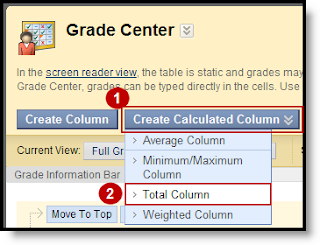
- create a letter grade total column in Blackboard. Instructions here, at the BB help site, for creating a total column. Remember to choose "primary display = letter"

Then follow the ASU Roster Grades Instructions page embedded deep in BB help files:
- designate your created column as the external grade column to export (#1 on ASU Instructions page)
- verify that the Blackboard default letter grade conversion scale is same as your scale (#2 on ASU Instructions page)
- export your BB grades (#4 on Instructions page)
- verify and post grades in Roster grades (#5 on Instructions page)

Note: Ignore step #3 in ASU Instructions. It assumes you're giving up your BB total-pts column after converting the column to a letter grade. You do NOT have to sacrifice this column (an important record) to post grades.

Yes, there are a few steps to muddle through, but much much faster than posting each grade by hand. Congratulations on making it through another semester. Hopefully, you were able to do it with a little help from your friends.