I thought Guy Kawasaki did a great job of nuts and bolts beginner's look at social media. An offer to enter the short Linkedin course, unlocked for 24 hours. Take advantage of the access. Something for everyone, including how to offer a great, engaging short course:
I just finished watching Jeff Orlowski's "The Social Dilemma" now playing on Netflix.
I should have known, (I do teach a class on Social Media) and I guess I did know. In the class, we talk about our tech addictions, which platforms, what we can do about them. We read Andrew Sullivan's seminal, early work on the topic ("I Used to Be a Human Being"), and we work on creation of content that promotes social good. I did know that a few young, white boys in Silicon Valley used a convergence of persuasion technology, psychology, algorithms, and ruthlessness to create addictive design.
"If the product is free, then you are the product." Your data is the product, your Pavlovian responses are the goal - ruthlessly applied so that they make money on every click.
After watching the movie, I turned off notifications everywhere; deleted FaceBook on everything but one laptop; deleted Twitter everywhere (I'll use the web), and I promised myself not to post anything political when feeling frustrated by the noise/news of the day. Political posts from me sway no one; I'll leave it to experts to do the research and their journalistic jobs.
I deleted Instagram ages ago. Never understood the appeal of Pinterest - given my home looks like a summer camp, perhaps that's not surprising.
Watch the movie. The very men who created social media explain the damage they've done. Political polarization, echo chamber connections, trolling, teenage bullying and the loss of self-esteem - including self-harm and suicides, conspiracy theories and rising movements of hate, Russian interference and manipulation of elections and lives. All of it, as these men intentionally conditioned us to go deeper into the rabbit hole, to lose track of time, to seek ever more unsatisfying digital validation, to alter ourselves with endless selfies and selfie-filters, and more and worse and never-ending and no solution in sight to put this evil genie back in the bottle. (PS: they're sorry. Oops.)
No solution, except for each of us to recognize the harm, pull ourselves out, and advocate for regulation.
A friend asked me whether I thought we'd be less selfish, less capitalistic, more concerned with the missing US safety net when we come out of the Coronavirus crisis. So many good things came out of American hard moments (Social Security, WPA, Medicare/Medicaid, unemployment insurance, SNAP, Pell Grants...) Could we do it again? Come out of this hard moment kinder?
My answer: I hope so. That's all I've got right now - but let me tell you how I got there, from "nothing else to do" observations and pondering how the personal is political.
First, I've realized that no one has EVER cared what I looked like, now that I've been cutting my own hair and doing my own nails for months. The "nails" part is clipping when they looked like claws or get snagged in my socks; the hair is holding it away from my head and hacking with kitchen shears. No one noticed, no one cared. Granted I don't see many people, but with summer, I am now making an effort to meet friends outside while the weather is lovely. If you're not making great effort to do this, start. You'll be sorry you missed your chance later, in the cold and dark seasons of Covid, AND when you finally share a walk or glass of wine, you realize your friends care about you, not how much money you spend on your grooming. Maybe post-pandemic, we'll be less primp-centered and spend our spare time contemplating how we let an incompetent administration kill so many of us, sicken so many of us, trap so many of us for so long?
More evidence that we care about you, not your primping:
I do shower before meeting up with people, but on isolation days? The whole day slips past and no moment was the right one. People didn't use to bathe every day. So, I'm time traveling with Covid back to simpler times and it seems to be working out.
Attire: yoga pants and a floppy shirt. I just can't pay a lot of attention to my clothes right now. Sitting outside with friends or walking in the park is a rather informal affair, so - informal garb. On non-visitation days, it's hit or miss. Whatever I tossed on that morning is the same "style" I now use to dash into the grocery store or PetSmart. I do dress up for my doctors' appointments. I'll have to ponder why I want to impress them, but even then, it's not what I wore to work back in the day. Those professional clothes sit in the back of the closet.
I have a few Zoom shirts ready for business-style meetings. (I'm not a hooligan!) And I even make it a point not to stand up and let them see my dog-hair yoga pants.
My mom used to say "We'd worry less what people thought of us if we realized how seldom they do." It used to hurt my feelings as she always said it when I was taking too long primping or asking for brand name clothes. I understand her point more deeply now that I see people less. It's a bit liberating.
Thanks for reading about my new grooming habits, and how they've made me easier and less self-centered. I hope that equates with a bigger heart and better use of time. Like mom told me, I'm not going to worry what you think of them (or me). It's just me, pandemic posting, and you'll forget you read this very soon.
I've been noting (maybe obsessing on) the low level anxiety, sadness and loss that accompanies this pandemic and how it's changing my personality and those of loved ones. You note it also in the tense vibrations of the person near you (6 feet!) in the grocery store or in the car ahead of you, honking their horn or forgetting to turn.
Me: I'm slower, sadder, quite a bit dumber/scatter-brained, and lethargic to react. BUT in the last week, summer burst onto Tacoma. Yes, we start summer late here in the PNW, and never expect sunshine till the 4th of July. I always hope for downpour that day, so people blow less fireworks and Max and I spend less time huddling in bed or the closet.
Today, oh it's gorgeous. We walked in the park, then I had coffee and read the news on my rooftop deck. Later, we're headed for a walk on the waterfront. (Click on lovely pic from @RaviPatel above, more at https://photosbyravi.com/). Outside, well-distanced from other humans, I keep beyond the 6 foot barrier and pull my mask down and just breathe. Max and I wander - sniffing green, sea, summer air, and living things. He has little understanding of Covid, although he's become even more skittish - most likely reading my stressors.
Ignoring this undercurrent, I can't help but note how summer makes it easy to forget: that I'm lonely, high risk, might die, might live but suffer. In summer moments, with the sun on my face and Mount Ranier letting me know all is right with the world in this moment -THIS moment - my sadness and anxieties drop away and life is glorious. THIS moment. Hold onto that wherever you are and create your one perfect moment. Make a cup of tea and breathe. We're in for a long haul.
Moving through the pandemic is happening in slow motion here in my home, my circle, my small and infrequent experiences as I shelter away from the madness. With only small bits of work, few interactions, little responsibility I find myself trudging through each day. Today, I told my god-daughter that I did nothing yesterday and it took me all day. AND it left me exhausted.
Lists of things to do which would have numbered 5-10 on a normal Saturday now have 3 at most on whatever day it is that I just can't recall. Tuesday, Friday, Someday in July? And of the 3 things on the list (yelled to Alexa, as it's too much work to find paper and pen), I cross off 1 or 2 and move the others over to Someday/Whatever Day+1.
This can't go on this way, can it? I feel as if I'm in fog, on water, far from shore. Rather than a paddle, I pick up my phone and read the news, browse FaceBook, read another novel on my Kindle. Sometimes I watch Netflix, sometimes I go to bed. Or I don't go to bed and read till 2am. Because what is time when there's no sense of the day?
I want to do better, want to be better, want to seize the day (whatever-day) and make the most of this reset in momentum. Maybe reset, stop, head in another direction? Up?
Hello, peeps! I haven't been posting for a long time. This long-form communication seems to have become reserved for those privileged with time and resources to research and think deeply about issues that matter. Certainly many of us have witnessed how this way of navigating the world becomes more and more of a rarity in our lives and those around us. We work long hours, rush to manage the simple daily acts of love and laundry, spend too much time texting, FB-ing, Instagram-ing (so instant!) and worse. Even our president spends hours tweeting instead of reading complex government briefings. We are lost in the digital clouds.
But here in higher education, as we move increasingly more surely into becoming cyborgs, I find that those moving most quickly ask (and are held accountable to answer) tough questions not asked of their seat-in-butt classroom peers.
One question that comes up OFTEN is how to better use discussion boards to create engagement, inquiry, reflection. I love some of the methods my colleagues are using, and I admired the inquiry found in this recent reading I came across that summarized the work of my community of peeps to continue to find better ways to create engagement, learning, student success and path to graduation.
It's been a long, a long time coming But I know a change is gonna come, oh yes it will It's so odd when a song gets stuck in your head. When for no reason, Sam Cooke's voice starts up and it just doesn't stop. Why is that? Even more perplexing, I now find myself asking Alexa to play a song, and as it starts, I wonder 'why that song?' When I'm thinking about 100 other things, making dinner, or checking my email, I ask for a song long in the past and not heard for years. And now, I have to wonder if Alexa hasn't become some kind of therapist, bringing forward thoughts hard to acknowledge in the forefront, but clicking away behind the noise. It's been a long, a long time coming But I know a change is gonna come, oh yes it will I write about change in higher education - what it would take, the post-traditional students, eLearning, analytics, finance, student debt, adjuncts...CHANGE! Whether we like it or not. Whether we're ready or not. I write about it with some urgency, given my role of researching, recommending, cajoling, forcing, and implementing change on my campus. But the fact that Sam Cooke is popping into my brain surprises me, as I usually don't write about it with the heavy heart imbued in his song.
I think I'm getting tired. I do believe it's coming - that change, that oncoming train, that fierce wind - but as Sam says "a long, long time coming" and so many lives ruined in the process. Student debt: $1.4 trillion in student loan debt, spread out among about 44 million borrowers. The average 2016 graduate has $37,172 in student loan debt, up six percent from last year. Graduates today are putting off moving out of their parents' homes, having children, buying a house. They are trapped in a perpetual, grinding adolescence. Adjuncts: More than half of US faculty are part-time and even when full-time, ~70% of all faculty are not on the tenure track. We are educating scholars, in a grueling PhD process, for careers no longer attainable. Loss of public trust: Not unique to American institutions, where the public has lost faith, partly because of economics, of deep political divisions, and frankly, because large institutions (government officials, higher education, the medical community...) have squandered good will with a recklessness that takes our breath away. We could fix it voluntarily or we can be pushed to the wall. My fingers are crossed we go with the former, but the academy is faculty-governed and what's in their best interests is not beneficial to students, parents, communities, the Boards of Regents. It's a wait and see. But I know a change is gonna come, oh yes it will Here's the thing that exhausts me: some of the best minds tackling this problem lay outside the academy, and we ignore them. The ones inside are being shut down, silenced, asked to step down, denied tenure, denied the ability to teach in new formats. On the administrative side, change agents don't stay. They burn out or get pushed out. Faculty voices that are rising, asking for an end to the hiring of bureaucrats, aren't complaining about good leaders being hired to do good work. They're pushing back against all the obstructionists settling in for life - still refusing to use calendaring, to return emails, to look at data...to change. Some are pushing back at the endless stream of offices supporting division and identity politics. And thus the sorrowful, Sam Cooke sounds that accompany new research on the state of higher education. It's been a long, a long time coming But I know a change is gonna come, oh yes it will I believe that.
Interesting report from the 2017 Online College Students survey. Things we should have guessed, but nice to see validated. What did students say? They want an engaging, quality education. They want to be a part of a community, and want their instructor to be accessible. Online students are students first, and want what students have always wanted. To make meaning of the world. And yes, as "non-traditional students" become the tradition, more than 1/4 of the 20 million students now in college are taking some number of online courses. They want flexible, technology-infused choices. At UW Tacoma, we're still behind the demand curve, with 15% of our students signing up for all our online courses within hours of opening for registration. They want more reduced seat time options, but not at the cost of quality. The want to love their courses, but they WANT online and hybrid courses. (This summer, a course with an enrollment cap of 30 had almost 80 students put their name on the waiting list, but no one dropped the course. Eight of the top 10 Wait List courses were online. The other two were pre-reqs that students desperately need. We're working on listening to the needs of our students, but change is hard.) We hear you, students of UW Tacoma and the 5 million+ now taking online courses. We're working on it. -Colleen
The dreary season of 2016 is rushing past my ears, sounding like a hummingbird heading for home. I thought there would be time...to reflect, to learn new tools, to come to conclusions regarding practicing practices and troubling tech. Instead, I ran as fast as I could just to stay in same place.
But I promised a few colleagues that I would document '3 before me' - Academic Technology's ode to setting tech limits in Canvas - in time for Winter quarter. Here's '3 before me!' in micro-content form:
The Practice
Tell you students not to email you, unless it's personal/private/confidential. Tell them you will not answerIf they have a question on the content, others probably have the same question and you don't want to answer it 30 times. Tell them here are 3 places to go before your mailbox. You can do this!
#1) The course FAQ thread in Discussion Board. Someone will answer it there, often before you, the instructor, even sees it.
#2) The University Help Desk. You're not Tech Support and you don't need to know why their Windows Vista/BB9/IE8 combination doesn't display PDFs correctly. IT is paid to explore those issues, and some of them enjoy working on the problem.
#3) The syllabus. Doh! Time, due date, requirements, process is usually outlined there. If it's about course content issue, they should look there first.
3 before me. Easy rule. Put it in the syllabus and your online teaching becomes easier and your students become less dependent. Scout's honor.
Lots of faculty think they'll be seen as "nice" if they ignore this advice. Do so at your own peril. Online options can grow work at exponential rates when you start obsessing. '3 before me' is especially gold in online teaching. Why?
so you don't burn out teaching online
so students take ownership of their learning and problem-solving
so they form community unto themselves
You can do this. You can set limits, encourage problem-solving, create more collaborations. 3 Before Me.
Seems every time I opened my Inbox or Facebook page last week, some friend would send me another link from the net telling us how quickly the higher education milk is reaching the smelly moment when you gag. Right now, most brave souls either don't stop to sniff or they think "What the heck. It's still ok. It's...fine." They have hope - and strong stomachs.
We admire people with strong stomachs. The weak and squeamish? Too bad. Let them drink water. Eat dry cereal. Sip black coffee. Dip cookies in Coke. It's good enough. Of course we remind them it would be better to just buck up, suck it up, endure. Like Marines. If the student debt doesn't kill you, it will make you stronger. If the 20th century curriculum doesn't break your spirit, you'll be tougher to kill later on. If the adjunct campus-hopping commute at inconvenient hours doesn't conflict too much with your employer's expectations, you'll make it through another quarter. Until quarter by quarter and deeper in debt, we will give you a degree. That may or may not help you get a job. We make no guarantees. As Rolling Stone magazine points out in their crushing story on Ripping Off Young America,,
Between 1950 and 1970, sending a kid to a public university cost about four percent of an American family's annual income. Forty years later, in 2010, it accounted for 11 percent. Moody's released statistics showing tuition and fees rising 300 percent versus the Consumer Price Index between 1990 and 2011.
But, hey, that's not our fault. When milk spoils, you don't blame the milk. We had to raise tuition rates. We needed a climbing wall and new stadium; a gourmet dining hall for our honor students; ones that look like the Hilton penthouse suites. You made us do it. Remember when the country was spending like mad and we wanted a seat at the party? Still paying the bill.
Plus, everyone reminded students that it was worth the cost: A better life, better job, more stuff. Again, not our fault that this may not be true. Not our fault. No one told you to major in history. Didn't you see the flyer on STEM? Science technology engineering math, dude (and dudettes; especially dudettes!). In a very bad economy, there are still a few good jobs out there. But just in the applied professions. With a history degree, there's a good chance you'll be working retail. Sorry we didn't explain that, but you didn't ask and we don't actually work out there. How would we know?
2016. Blech. Feeling inconsolable and thus a bit lazy. Wish I could share some thoughtful, insightful, encouraging words as we wrap up a very perplexing 2016 and inanely place our hopes in a basket for the coming year. I'm writing a 2017 essay for the Evolllution regarding looking forward, not looking back and doing right for higher education with technology. Will pull myself out of the soup, find renewed confidence in my community's ability to do good in the face of...bad, and post when it's published.
Meanwhile, let me instead just send you on in these cold dark and dreary days of December to the annual review of a writer who never loses her spunk and energy to rouse rabble in the face of infuriating odds. One of my favorite hackers, activists, feminists, thinkers: Audry Waters. Here's her take on 2016. It's in six thoughtful parts on life, ed-tech, staying sane, doing good. If you can't read them all, give up showering for a week and read them all.
Today's reading: A college degree is worth less if you are raised poor. My friend Debra, a sociologist dedicated to "doing the work" of social good, would often talk with me about what was broken and what was beautiful in a college education. In this knowledge age where industry jobs are disappearing, the American dream now includes the expectation that college is available to all. Which means higher education is being asked to rethink what we do and who we do it to.
Many campuses must now change their mission from one of exclusion to something greater where every American who wants to go to college can find a way. The challenge is not to simply expand and admit, but to CHANGE (ouch) and adapt ourselves to the needs of the post-traditional / new traditional learner. Debra and I used to talk about what that might look like and what it would take not just to teach history and math and science and lit...but to teach that "je ne sais crois" that allow first generation and socio-economically disadvantaged students to demonstrate what used to present as old-school educated. The topic, fraught with land mines, was really about class and culture. Which college never taught us. Wealthy students came to college with the trappings of class: how they spoke, ate, dressed, their manners, their confidence with peers and deference to those above them by age, expertise, power. Coming from an inner city lower middle class, but having traveled all around the world, earned a PhD, lived in France and spent most of my life working at universities, I asked my very-privileged class friend if I had adapted and passed? "Sometimes," she replied. Wait, I live a life of privilege and still sometimes I don't pass? WTF?? Debra would say using that acronym is an example of 'where one comes from'. But it's my choice: an acronym I'll use on this blog with you, dear reader, but not in the Board room, classroom, stiff social settings I'm now often and unhappily placed. They are settings still outside my class and comfort zone but I know how to put on class airs to please, to disappear, to pass. Sometimes. So what about our students that are now $30,000 in debt for a bachelor's degree? Who have not traveled and tried? Who never realized that their instructors did not dare approach the difficult topic of how to behave in a way that will make student debt a return on investment? Not our job, we lofty historians, mathematicians, scientists, scholars. It is a hard topic, easily shunted aside as impolitic as we do what we've always done. But sometime soon when the longitudinal studies show us that we took the money and didn't deliver what the new traditionals needed? When we read that they are no longer young, in debt and not getting out? Will we still be saying "not our job?" If so, I hope we have the class to show shame and remorse. So, a start at conversation from the Brookings Institution and how next to "do the work" - A college degree is worth less if you are raised poor.
As many at UW Tacoma know, we are / have been / will continue to be swept up in change. It's inevitable as society changes to digital; as our students now better represent the whole rather than the privileged few; as our campus leadership changes; as our faculty think about unionizing to counter the increasing hires of PT and FT lecturers, as globalization and technology change everything around us. Many realize we must now change our teaching to keep up and to be responsive to the students spending so much money to be here, but find they can't stay here. SO: we now have a Lower Division Task Force to examine why we lose ~50% of our first year cohorts before graduation day. To figure it out, we can't look to story or blame or if only wishes for days gone by. Instead, we're gathering artifacts that might provide new ways of educating lower division students. Here's one people might want to ponder: the National Survey of Student Engagement's latest report on the students' perceived experience of undergraduate education. Some reveals: they want to be challenged with relevant, engaging work; they want more creative work; they feel more engaged and challenged with online experiences. Financial stress was
common among undergraduates, particularly
among first-generation, women, Black,
and Hispanic students. Here's hoping the Task Force considers the voice of students in defining change, and rewarding the faculty willing to embrace change for the good of our students. We can yank graduation rates higher than 50-some per cent. If we're willing to change, to be uniquely UW Tacoma, to be the campus that responds to student need with thoughtful, innovative, data-driven solutions. If not us, who? If now now...2016 so bright, we should be wearing shades.
Every year, as if in mini-birthday celebration, I anticipate the New Media Consortium's Horizon Report. Even years when it's off, hijacked from relevancy by the futurists that often pack the democratic and process-oriented panel choosing the issues, it's a great read on the emerging technologies that will affect higher education in 1, 2-3, and 5 years. Well, it's out and it's deeper, more thoughtful and more balanced than ever before. READ IT! What I love about this year's report is that they took on more than technology. That crystal ball approach to bright shiny objects often seemed to ignore the reality of adaptation for those working in the trenches, in the classroom, in technology. Consultants living in the cloud can wax eloquent on how the "internet of things" will transform teaching and learning, but my campus struggles to keep bulbs lit in projectors and markers available on the white boards. Our idea of transformative practice is in finding the deep affordance in new features of the LMS, not MakerSpaces in my math course. Why does the most referenced research in higher education always talk about students as if they all study at the Ivies, when the mass of students now work, are in debt, go to public colleges and most often, community colleges? Where are the waves of transformative technologies for them? It seems NMC tried this year, and instead of focusing solely on shiny objects out of our reach (5,10, 20 years out), they address the challenges the rest of us have long been facing - solvable, difficult and wicked challenges. Well worth the read. Now if they'd stop putting 12-year-olds in lipstick on the cover, as if that is the current face of the nation now going to college, I'd give them an A for effort.
A Surprising Post from Me (and Clay Shirky). I love technology: my desktop, laptop, tablet, iPad, smart phone. GPS Wi-Fi Bluetooth. Apps, software and the internet of things. Devices and software that know me, inform, nudge, update and adjust.
I Google this and Google that, especially the new functions that support instruction and learning in higher education (Apps, Scholar, Drive). They make me a better teacher and my students more prepared digital citizens, critical thinkers, consensus-based team members. Love it all. But I'll be the first to admit that I have an advanced "monkey mind" when my devices beep, bing and buzz. I am easily distracted from hard, deep thinking by the lure of the next info-moment. I can disconnect from the present due to the lure of what I'm missing out there. I have learned to set boundaries and close my email, silence my devices, be here now when attempting to do good, hard work. Mindfulness matters. I know this about myself and I have the age, wisdom, commitment to my work to do that. (Most of the time.) My students do not, for a diverse variety of reasons. One reason is that "learning" is not their career passion. Another is that my course may not be as exciting to them as it is to me. Maybe they don't have practice in disengaging from the digital. So they come to class with monkey mind.
I've been aware of this for years, and adapting my teaching for years as a way of integrating their own technology into the curriculum. But while some are Googling the topic, answering my polls, collaborating on the shared notes -- others are checking Facebook and texting in their laps and our course is the less for their moment-to-moment absence. We can stop the monkey madness. Here's Clay's take on doing so: ban laptops, tablets and cell phones from the classroom. I concur. Image CC BY-ND from https://neurocapability.files.wordpress.com/2012/10/technology_1350331040_460x4601.jpg
That Beatles song keeps playing in my head as I read news about education, debt, public policy and the general modern-day miseducation of America. In Seattle, 100 or so K-12 teachers known as the Badass Teachers Association - aka (crazy as) BATS - marched on the Gates Foundation last month. They decided Bill Gates is personally responsible for holding them responsible for student performance on tests. They're mad as BATS, free for the summer, and want Bill (who has little say in proposals funded, but a public name and lots of money) to butt out in funding innovation proposals. (We don't need no stinkin' innovation.) They pooled money from somewhere to bring in keynote rabble-rouser Anthony Cody ("we hate STEM") from California as there doesn't seem to be enough rabble in the PNW. Bless their hearts for effort.
At the same time, in Tacoma, my colleague - the brilliant and thoughtful Ingrid Walker - led a discussion at the Grand Cinema after the viewing of The Ivory Tower. The documentary, and discussion, brought out a calmer, more diverse and less rabbly crowd. While focusing on hard topics explored in the film (cost, value, disruption, the new loss of trust by society in HE), the audience seemed aware that answers will only come out of very good, hard questions. But also that change is already in the wind, and it's bringing on a storm. Part of the storm, I believe, comes from people who don't want to think deeply and simply to blame. They ask questions that have the power of a slammed door: Who stole my lovely past? Who moved my cheese? Who let these low-brow, underachieving, non-elite, in-debt learners into college? Why can't we go back to the way it was before technology? What the hell is a MOOC really? Oh, and why doesn't Sal Khan just shut up about the value of personalized learning? Interesting questions, all. Won't get us anywhere. The reality is that we have left behind a golden past in the industrial age. A past where lock-step schooling was good enough to prepare poor kids for good, dull factory jobs. It paid the bills, bought small homes, and even sent (some, maybe) of their children to college. That doesn't work anymore and everyone from BATS to Bill Gates knows that. Despite/paceDiane Ravitch's empire and its claim all is hunky-dory, we have to do better. We have to change, to prepare for a knowledge age, to create affordable and achievable education for all, and educators have to stop whining about how it will inconvenience us to do it. Just do it. Just "do the work" as my friend, sociologist Debra Friedman repeatedly said. I hear her voice in my head all the time. Especially when reading the news today, Oh Boy. Do the work.
Rich kids. That's the bottom line. If you come out of a 2-parent family, went to a decent school, got mid-range SATs, then you'll be fine. But smart kids that come from disadvantaged backgrounds? Well, not so much. Multitudes now enter our higher education system, take out financial aid, and then wander away disheartened, distressed, and disappointed in themselves. Why, you ask? That's a hard question, and the ways of talking about it are legion, but I'm going to make it easy: higher education mostly doesn't care. We want learners to learn the way we learned; we want to blame them for lack of "persistence," faulty "self-motivation," and poor "self-discipline." Those students who don't have grit? Well, they didn't really belong here. I was in a webinar/short course, hosted by Dr. Patricia McGee and presented by EDUCAUSE/ ELI, when my heart cracked. Patricia presented research by Stanford-Bowers (2000) on retention factors in online experiences as perceived by three groups in a Delphi-modeled consensus exercise. Bottom line: we think it's the learner's fault and the learner thinks it is about flexible, engaging, relevant, responsive course experiences. Koyaanisqatsi; life out of balance.
Provided by Dr. Patricia McGee, based on work of Stanford-Bowers, 2008
It doesn't have to be that way. Instead of asking a new generation of Americans going to college to be different, to create their own safety nets, to suffer - we could change change. We could care more. They're trying it at UT Austin, learning to care, learning to change who gets to graduate with surprising results.
A short essay in the New York Times has been on my desk for months, yellowing at the edges, waiting to be noticed. It's there as a reminder that I've been meaning to say to my higher education friends "Hey, there's something important here, and we should talk about it." So here it is, The Code of Life, where Juliet Waters shares how simple coding has changed the way she looks at the world. Some of the issues she addresses resonate with how we live, teach, navigate the digital world.
"The biggest surprise has been the recovery of the feeling that my mind is once again my own. The “always-on” agenda of mobile technology, now visible to me in the very design of the devices, could not manipulate me as easily. Where my devices were interrupting my work or my life in these ways, I’ve had an easier time filtering and controlling them," she says.
I address this notion of owning your space all the time when explaining digital literacy. I teach meta-control of digital objects to my students. I yell responsibility from the rafters regarding core curriculum for the 21st century. I often address how the next generation is assumed to (ALL, universally) have a high technical understanding. They don't. They have gadgets, and use them in singular ways. They ARE a little more fearless with new gadgets than the previous generation. Young people are increasingly visual and love to take pictures, often selfies, but few of my students blog or tweet or reflect on who they are presenting as their digital self.
Waters addresses the power that a deeper understanding allows, even the simple power of being able to look behind the curtain of html. She also delves a bit into the hysteria of those who aren't interested in new literacies - especially the kings of text who resent giving up their supremacy - and how little they understand of the world most of us now inhabit, plugged into our smartphones, ipads, ipods, tablets, kindles...often all at once. We are all cyborgs now, as Amber ase so eloquently tells us, but we do NOT need to be slaves of our machine culture or the people watching us from the analog world. We are free.
For those of you who follow my research meanderings, you know I've been talking about Nudge Analytics, mobile nudges, and even more mobile nudges for awhile now. I'm excited about the evidence that Persistence Plus and University of Washington Tacoma have been able to gather related to mobile, whole-learner support in course performance and behaviors. (In our latest look at online math classes, 20% of PP participants made use of UWT tutoring center services while only 4% of the non-participants did. That's a huge behavioral difference, no? We nudged them to get help if they felt they were struggling. All you have to do is ask and advise.) So, it got me thinking...why aren't instructors doing the same with course tools available to us in the LMS? Ok, now available to some of us in some LMS. Next-gen LMS like Canvas that has amazing data tools under that pretty engine. I'm going to be presenting on this topic a number of times this Spring as I collect ideas and innovative practice for nudging, so I started the conversation at UW Bothell last week at a workshop/conversation there. I'll keep sharing, refining, asking questions in the upcoming months and I'm asking here. How can we use the tools in Canvas to nudge, remind, encourage, personalize, prompt, and support students - especially busy, working, distracted, stressed students - to better results? I note that I add the "especially" because this is the population going to college - the new traditional - that is seeing their safety net eroding daily. This is the population that can't afford rising tuition or increased debt. This is the population that struggles with jobs, kids, and an education system that ignores learning diversity, age, experience, preferences and needs. We are an instructor-centric, hegemonic blob that is allowing our vain desire and ravenous need to be Harvard (or UW Seattle) to blind us to the needs of our students. We're not Seattle; they're not elite, privileged, protected. I was reminded of the difference when I was at the mothership -UW Seattle - giving a talk on mobile nudge results. I received some strong push back regarding "pampering" and how it's not the instructor's job to "nurture" students. I was told that students "not mature enough" might not belong in college. Wait, what? A 30-some year old mother of three, juggling full-time work, student loans and parenting isn't mature enough? I think the mothership is ready to take off for Exclusivity Island. And that's ok, but there's a whole planet of learners that see a college degree as more and more necessary and they're looking to places like UWT and the state of Washington community colleges (ALL on Canvas) to help them get to their goals. We're not doing well at that and I'd like to talk about how we could do better by nudging, supporting, sharing and caring them to graduation.
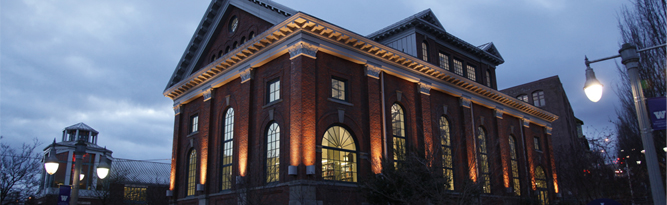
Many of you know that I lost my friend, mentor, collaborator, boss - true north guide - last month. Debra Friedman passed away from a very short battle with lung cancer. I hear her voice in my ear in so many moments, and if you knew her or would like to hear her voice (in a text fashion, but still we're academics here), her last publication came out posthumously this week. Conjecture, Tension and Online Learning is something we worked on for much of the time we've been together at UWT - two years! - as we sipped local wines, ate in "Grit City" speakeasy joints, cafes, wine bars and pubs of our Tacoma Theater District neighborhood, walked Max in the park of our new city. We loved our new campus, loved its urban-serving mission, its "new traditional" students, its historic warehouse architecture. We loved it all and worked hard to create a learner-focused, urban-serving university for the 21st century. Debra was a visionary and a tireless advocate for education as social justice. This piece, her idea, was a struggle to understand why the faculty we admired would so often fight change, fight innovation, fight doing the right thing. Or, as Debra used to say, to "just do the work." Here, our last finished project together and her last publication, is what we learned.